
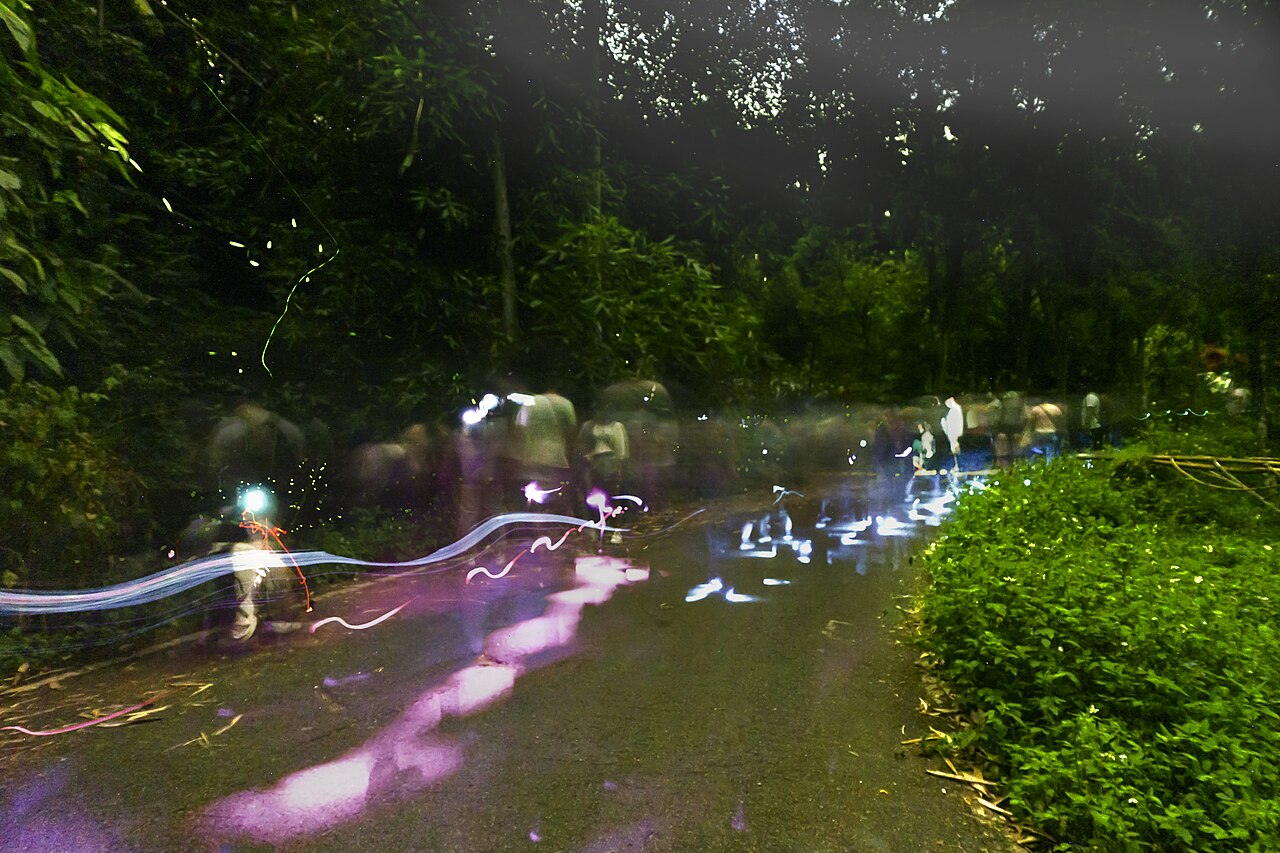
Imagine walking through a grassy yard in late July. The sun went down an hour ago. The air feels warm and still. Suddenly, a tiny yellow spark blinks near your shoes. A few feet away, another flash pops up near a low tree branch.
If you live in Pennsylvania, Michigan, or Indiana, you are probably looking at the Common Eastern Firefly. On Alitaptap, our citizen scientists reported dozens of sightings this week. People saw them in places like Lynn Township, Michigan, and Penn Hills Township, Pennsylvania.
These little beetles are playing a high-stakes game of hide-and-seek. The flying males blink a special flash code as they swoop over the grass. Female fireflies sit quietly in the dark blades below. When a female sees the right pattern, she blinks back. That is how they find each other, mate, and lay eggs for next summer.
Now imagine someone turns on a bright floodlight on the garage back porch.
Suddenly, the yard looks like mid-afternoon. The soft yellow blinks of the fireflies disappear into the glare. The female in the grass cannot see the male flying above her. The male flies around in circles, blinded by the lamp, unable to spot her quiet answer.
Scientists call this problem light pollution. Light pollution is extra man-made light spilling into the night sky where it does not belong. It is one of the biggest dangers facing fireflies today. But unlike many environmental problems, this is one you can help fix tonight right at your own home.
How Fireflies Talk in the Dark
To understand why night lights cause trouble, we have to look at how fireflies use light.
Fireflies make their own light using a chemical reaction inside their bellies. Scientists call this bioluminescence. That is a big word, but it just means living light. Firefly light creates no heat at all. Almost all the energy turns into pure, cold light.
Different species of fireflies use different light signals.
Take the Common Eastern Firefly. The males fly around near dusk and flash a quick J-shape with their bellies every few seconds. On July 27, 2026, Alitaptap members logged sightings of this species in places like Greenfield, Wisconsin, and Berlin, Maryland.
Other fireflies work differently. Consider the European Glow-worm. Alitaptap spotters logged sightings of this beetle in Bradenham, High Wycombe, in the United Kingdom, while iNaturalist observers found them near Pembroke, Wales, and Vizcaya, Spain.
With glow-worms, the female does not even fly. She stays on a stem of grass in the dark and glows with a steady green light. Flying males search the dark ground for that bright green dot.
Then there is the California Glowworm, spotted recently on NW Dairy Creek Road in North Plains, Oregon. Their females also rely on steady glows in dark woods to attract mates.
Every single species depends on one basic rule: the night sky must be dark.
What Light Pollution Does to Fireflies
Light pollution happens when artificial light spills into places where it is not needed. Streetlights, porch lamps, glowing shop signs, and car headlights all contribute to light pollution.
When night falls over a bright city or neighborhood, the sky never gets fully dark. Instead, it glows with a murky orange or white haze.
For a firefly, that bright haze is like a wall of noise.
Imagine trying to whisper a secret to a friend across a school cafeteria while a loud band plays right next to you. That is what a bright porch light feels like to a male firefly trying to talk to a female.
Here is what happens when artificial light floods a firefly habitat. A habitat is the natural home where an animal lives and finds food.
First, male fireflies stop flashing as often. When the surrounding area is too bright, their brains get confused. They think dusk has not finished, so they wait. But while they wait, precious time ticks away. Adult fireflies only live for a few weeks in the summer.
Second, females stop glowing back. Studies show that when bright light shines on female fireflies, many of them duck under leaves or turn off their lights entirely. They get scared of predators like birds or spiders seeing them under the glare.
Third, even if both fireflies keep flashing, they cannot see each other. A porch light can be thousands of times brighter than a firefly belly. The tiny green or yellow sparks get completely washed out.
If males and females cannot find each other, they cannot mate. That means fewer eggs get laid in the soil. Over just a few years, a once-busy firefly population can vanish from a park or yard completely.
What Our Map Shows Us
When you look at the Alitaptap map, you can see light pollution in action.
On July 26, 2026, an Alitaptap user spotted a Common Eastern Firefly on Driggs Avenue in New York City. That is exciting because it shows fireflies are tough. Even in one of the brightest cities on Earth, a few fireflies manage to survive in dark park corners or quiet backyards.
However, sightings in big cities are much less common than in rural areas. We see far more reports coming from dark, open spaces like Bucyrus Township, Ohio, or Leavenworth, Kansas.
In dark rural neighborhoods, fireflies have plenty of space to flash without competing against giant streetlamps. But as towns build new housing developments and add bright streetlights, those dark pockets get smaller every year.
Firefly larvae—the baby fireflies that hatch from eggs—live in damp soil and leaf piles for up to two years before becoming adults. A larva is the young stage of an insect before it changes into an adult. If an adult female cannot find a dark spot to lay her eggs, the whole cycle breaks down.
Four Simple Steps to Save the Night
The great thing about light pollution is that it is easy to fix. Unlike trash in the ocean or chemical pollution in rivers, light pollution disappears the second you flip a switch.
Here are four specific things you and your family can do tonight to make your yard safe for glowing bugs.
1. Turn Off Unnecessary Lights
The simplest fix is the best one. Turn off your porch lights, garage floodlights, and decorative outdoor lights when you go inside for the night. If your family wants security lighting, ask them to set up motion sensors. Motion sensors keep lights off until someone actually walks by. This leaves the yard dark for fireflies most of the night.
2. Point Lights Down
Take a look at your outdoor light fixtures. Do the bulbs shine out into the trees and up into the sky? Or do they direct light down toward the ground where people walk? Shielded light fixtures have metal caps that force light downward. This keeps the light on your driveway while keeping the air above your grass dark.
3. Use Warm, Red, or Amber Bulbs
Bright white and blue LED bulbs are the worst for fireflies. White light mimics daylight and scatters across long distances. Red and deep amber light waves travel shorter distances and disrupt night animals much less. Replacing bright white outdoor LEDs with warm yellow or amber bug bulbs makes a huge difference.
4. Close Your Blinds at Night
Light from inside your home can leak through windows and illuminate your lawn. Draw your curtains or close your blinds after sunset to keep indoor light inside where it belongs.
Map Your Yard and Help Scientists
Fixing your lights helps your local fireflies right away, but you can also help fireflies everywhere by sharing what you see.
When you join Alitaptap, you can mark where you see fireflies in your neighborhood. You can also note how bright the area is. Is your yard totally dark? Are there streetlights nearby?
Scientists use Alitaptap data to answer big questions. Are fireflies coming back to neighborhoods that switch to shielded streetlights? Which species are tough enough to survive near city lights, and which ones need total darkness?
Every time you log a sighting—whether it is a Little Gray Firefly in Ottawa, Ontario, or a Black Firefly in Truro, Nova Scotia—you add another puzzle piece to the map.
Tonight, take a walk outside after dusk. Look at the lights around your house. Turn off what you do not need, step into the dark, and watch for that first yellow blink in the grass.